Drone Thermography to Inspect Domestic Solar Panels

Drone Thermography to Inspect Domestic Solar Panels

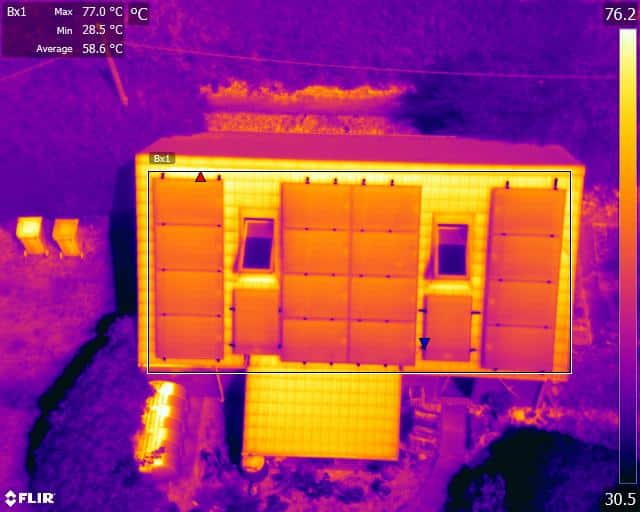
Using Drone Thermography to Inspect your Domestic Solar Panels

Domestic solar panels are now a familiar sight on the rooftops of the UK, but many people fail to carry out the necessary maintenance to make sure that they are getting the most from their investment.
Faults in your panel, either caused during the installation process or occurring over time, can not only mean that your panel’s productivity falls.  It can also cause a fire risk and so many companies recommend a biennial inspection to ensure safety as well as optimal performance.

Of course, the vast majority of solar panels are installed on sloping roofs which can make a manual inspection difficult and invasive scaffolding or a cherry picker may be required and there is always a risk of damage to the roof itself during the inspection process.  So, it’s not surprising that many people put off the cost and inconvenience of an inspection if there no visible issues.  However, drone thermography can complete a detailed panel inspection quickly, simply and cheaply with maintenance teams only then being required if a fault is found. One simply flight every two years under the right conditions can be all that it takes to make sure that your solar panels stay safe and efficient.  With many panels being covered by a long term warrant, there’s a good chance that fault repairs will be at no cost to the panel owner as well!

Drone Thermography of your solar panel can detect

- Faulty cells
- PID faults
- String errors
- Defective Diodes

All of these can be visualised without ever touching the panels or roof structure – making it the perfect routine inspection tool.  Drones can also be a fast and efficient diagnostic tool to pinpoint faults when production has dipped to be able give to your panel maintenance provider.

Drone Media Imaging can fly a state of the art thermal imaging camera on one of our top of the range UAVs for a very competitive rate, wherever you are in the UK.  We are also qualified thermographers which means that we also understand the correct flight conditions necessary to create meaningful and accurate data and provide you with a detailed inspection report. Just get in touch to discuss your requirements.

#aerialthermalinspection #domesticthermalimagepanels #dronethermalinspection #housesolarinspection #photovoltaicsolarpanels #photovoltaicsolarpanelsinspection #photovoltaicsolarpanelsthermalinspection #solarpanels #ThermalImaging #thermalsolarpanelinspection


https://www.dronemediaimaging.co.uk/using-drone-thermography-to-inspect-your-domestic-solar-panels/

Comments

Popular posts from this blog

Why Should Solar Panels be Professionally Maintained?

Why Should Solar Panels be Professionally Maintained? Over the years, panels can suffer faults that remain invisible to the naked eye but which impact their efficiency in terms of generating power. In serious situations these faults can even lead to a fire hazard. So it’s really important to keep up with the maintenance on your panels to keep your installation safe and also to make sure you are making the most of your investment. Obviously, the problem with regular and specialist inspection of your panels is that they are most likely to be in inaccessible areas of your home such as your roof. Having an actual human being up there to manually test each panel can be costly due to the health and safety precautions they have to take and potentially equipment they have to hire in order to gain access, plus you run the risk of damage to your roof structure during the inspection process. However, there is a simple and non-invasive solution that reduces inspection costs and means that if you d...

Solar Panel Faults - Common Types and Causes

Solar panels are a popular and efficient source of renewable energy that can last for decades. However, like any other technology, they are not immune to faults. Identifying and fixing faults in solar panels is essential to ensure their long-term functionality. In this article, we will explore the common types of solar panel faults, their causes, and how to prevent them. Solar Panel Faults: Common Types Hot Spots A hot spot is a concentrated area of high temperature on a solar panel, usually across a single cell. It occurs when a section of the panel fails to convert solar energy into electricity and instead absorbs it, causing heating. Hot spots can lead to panel damage, reduce efficiency, and in extreme cases, potentially start a fire. PID (Potential Induced Degradation) PID is an electrical phenomenon that causes a significant drop in the output power of a solar module panel. It occurs when a voltage difference develops between the solar cells and the grounded frame, leading to a le...

Common Causes of Solar System Under Performance

Not All Solar Panel Issues are Electrical Cell or String Faults Dirt on the Panels One very common cause of panels not functioning effectively is simply that they have become dirty over time, particularly in urban city locations, this can diminish performance by up to 10%. Regular panel cleaning can solve this problem. Check out our article on how to safely clean your solar panels here. However, if your panels have been on the receiving end of lichen growth or bird droppings, it is possible that hot spot damage has been caused that cleaning off the surface won’t fix. So, once you have cleaned your panels, you might still see that they are not operating at an optimum level. Shadowing / Shaded Panels It might be that your solar panels are being partially shaded.  For example, by trees that have grown since installation. Whilst this won’t damage your panels, it will be worth clearing any overgrown trees and large shrubs so your panels can once again enjoy a clear view of the sun. Degr...